Electrolysis Wheels Increasingly Common in Java's Aquaculture Ponds: Visit the Location Nearest You
Every shrimp farming cycle starts with something that is often overlooked: water. If the water entering the pond is not sterile, the risk of disease comes in with it. For years, the most common answer on shrimp farms has been chlorine (kaporit). In 2026, FisTx introduces an alternative: Cakra Elektrolisis, an electrochemical water sterilization system designed to replace chlorine.
Cakra Elektrolisis is now easier to find on shrimp farms across Java. From Banyuwangi in the east to Serang in the west, the system is already installed and working in the field. This article invites you to see it at the location closest to your farm or office, and to verify it for yourself.
Why Java Is the Proving Ground
Shrimp is a key commodity in Indonesian aquaculture, and the opportunity is still wide open:
- Production is still far below target. As of April 2026, the Director General of Aquaculture at the Ministry of Marine Affairs and Fisheries (KKP) said national shrimp production was just over 1 million tons, while the target is around 2 million tons per year.
- Exports are growing. Indonesia’s shrimp export value from January to September 2025 reached about US$1.4 billion, up 17.5% from the previous year. The United States took 63.1% of these exports.
- Land is abundant, but intensification has only just begun. Coastal land with aquaculture potential is around 600,000 hectares. About 300,000 hectares are used for shrimp, and only around 3% (roughly 15,000 hectares) is managed intensively.
- Java is a production hub. East Java, Central Java, and West Java are among the country’s main shrimp-producing provinces. One journal publication citing 2022 data recorded East Java’s vannamei shrimp production at around 103,950 tons. The government has also chosen Kebumen, Central Java, as a model shrimp farming area of about 100 hectares.
The message is clear: as national production is pushed higher and farming becomes more intensive, water quality and biosecurity become a foundation that cannot be compromised. KKP itself stresses that strengthening the industry starts upstream, including the use of environmentally friendly technology.
Chlorine: Cheap at First, Troublesome Later
Chlorine is widely known, but using it means buying, transporting, storing, and handling chemicals regularly in every cycle. These costs repeat and eat into farmers’ margins.
Cakra Elektrolisis is here to break that pattern. The system sterilizes water electrochemically, without chlorine, and is part of the FDS (FisTx Disinfectant System) together with Baskara UV and Nano Disinfektan. At FARM 2026 (September 29, Swissôtel Jakarta PIK Avenue), the live demo of how it works was one of the things that drew the most attention from visitors to the FisTx booth.
Four Areas, Four Places You Can Visit
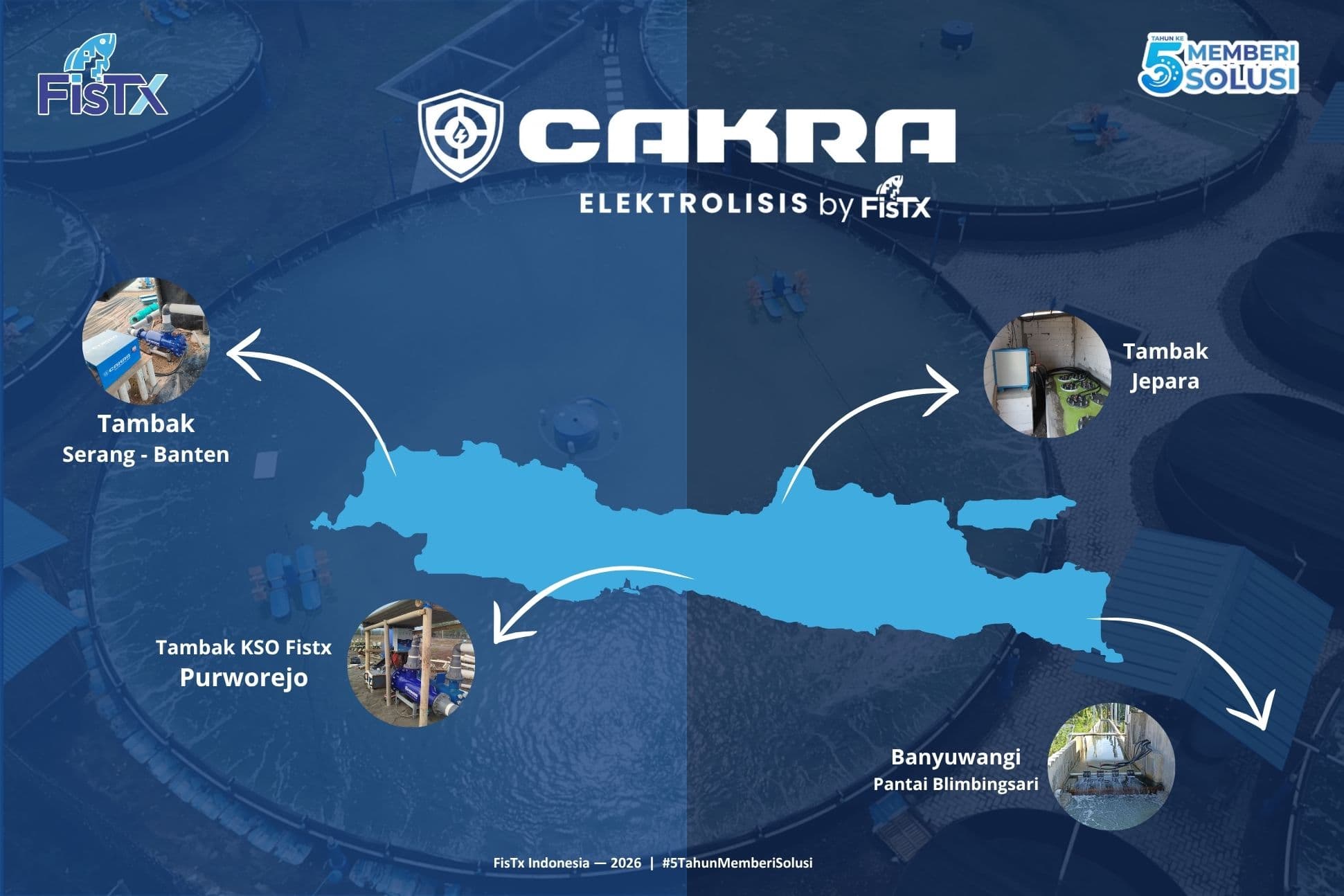
Cakra Elektrolisis is no longer something you can only see at an exhibition booth. Throughout 2026, the system has been installed and is operating on shrimp farms in four strategic areas of Java: the east, the west, the south coast, and the north coast. You can visit and see it in person.
| Area | Installation location |
|---|---|
| Eastern Java | Banyuwangi, Blimbingsari Beach |
| Western Java | Serang City, Banten |
| Southern coast of Java | Purworejo, FisTx KSO Farm |
| Northern coast of Java (Pantura) | Jepara, PT Ghana Utamadi Dhuniara |
The locations cover the far east, the far west, the south coast, and the north coast of Java, each with different water characteristics and farming practices. You can choose the site whose conditions are closest to your own farm.
What the Results Look Like in the Pond
One set of data we have received comes from the Banyuwangi farm (Blimbingsari Beach), which has been using Cakra Elektrolisis since April 2026. Below is data from Pond B7, from the first harvest cycle after implementing Cakra Elektrolisis (July 2026):
| Parameter | Result |
|---|---|
| DOC (days of culture) | 80 |
| Pond area | 5,000 m² |
| Harvest size | 46.8 |
| Total harvest | 9,501 kg |
| Fresh | 9,342 kg |
| FCR | 1.21 |
| SR (survival rate) | 82% |
This is only one pond in the first cycle, and we will keep updating the data as more cycles are completed at other locations.
No Need to Just Take Our Word for It: Come and Verify It Yourself
We understand that shrimp farmers and potential users do not buy technology from brochures. That is why verification is now much easier. With four locations across Java, you can simply choose the one closest to your farm or office, and then:
- Choose the nearest site from the location table above.
- Contact the FisTx team to arrange a visit and water sampling schedule.
- Take water samples and test them at a laboratory of your choice.
- Compare the results with the water conditions at your own farm.
The data you hold is data you collected yourself.
One Technology, Different Specifications for Every Farm
Every farm has its own story: pond size, water source, salinity, stocking density, and operating practices. That is why Cakra Elektrolisis is not sold as one size fits all. The right specifications must be adjusted to field conditions so that performance is maximized.
Ready to Try It on Your Farm?
Contact the FisTx technology team for a consultation and to get the Cakra Elektrolisis specifications that fit your farm’s conditions. Consultation and survey services to determine the right specifications for your farm are available via WhatsApp: +62821-239-9971