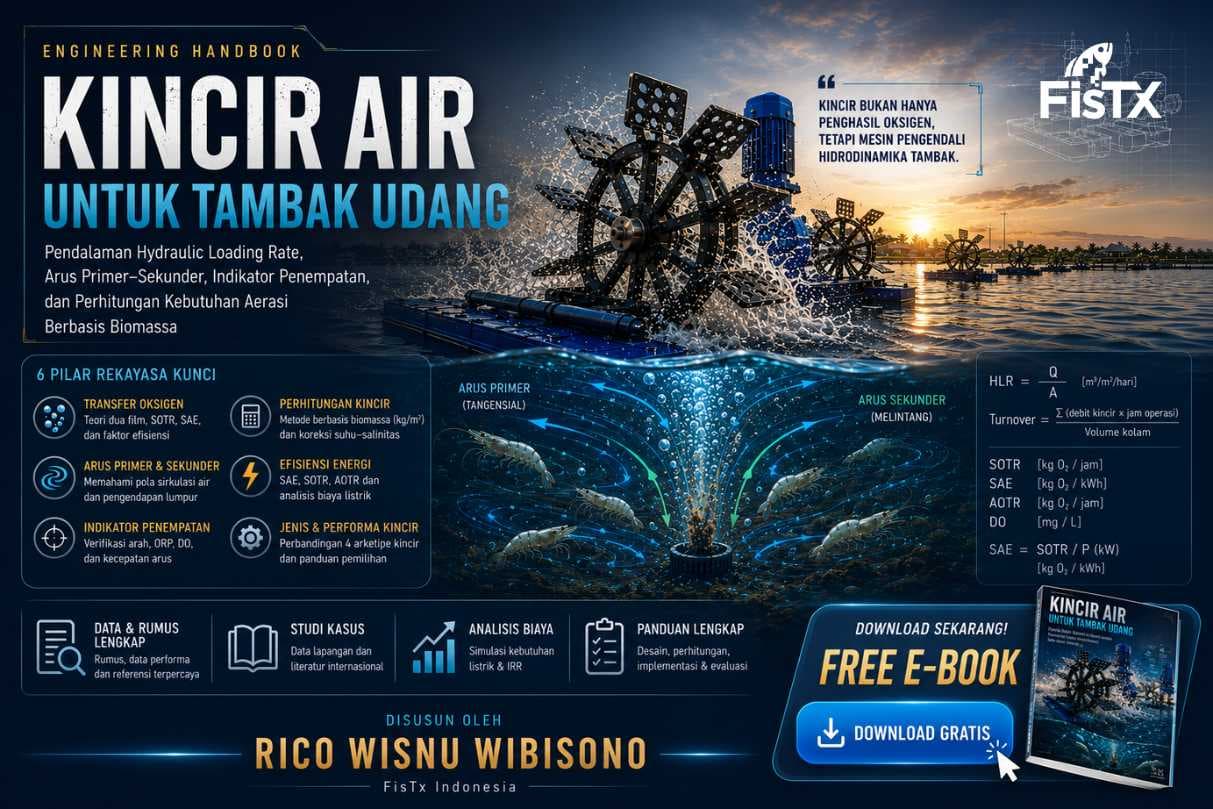
A Complete Guide to Calculating and Installing Shrimp Pond Aerators by Rico Wisnu Wibisono (CEO of FisTx)
Water Paddle Wheels Are More Than Oxygen Suppliers—They Are Engineering Components That Determine the Success of Intensive Shrimp Farming
Water paddle wheels are often seen as simple aeration equipment in shrimp ponds. In reality, they are one of the most critical engineering components that determine production success—from how efficiently oxygen is transferred into the water, to how sludge and uneaten feed are directed toward the pond center, and whether low dissolved oxygen (DO) events can be prevented before they negatively impact feed conversion ratio (FCR) and survival rate.
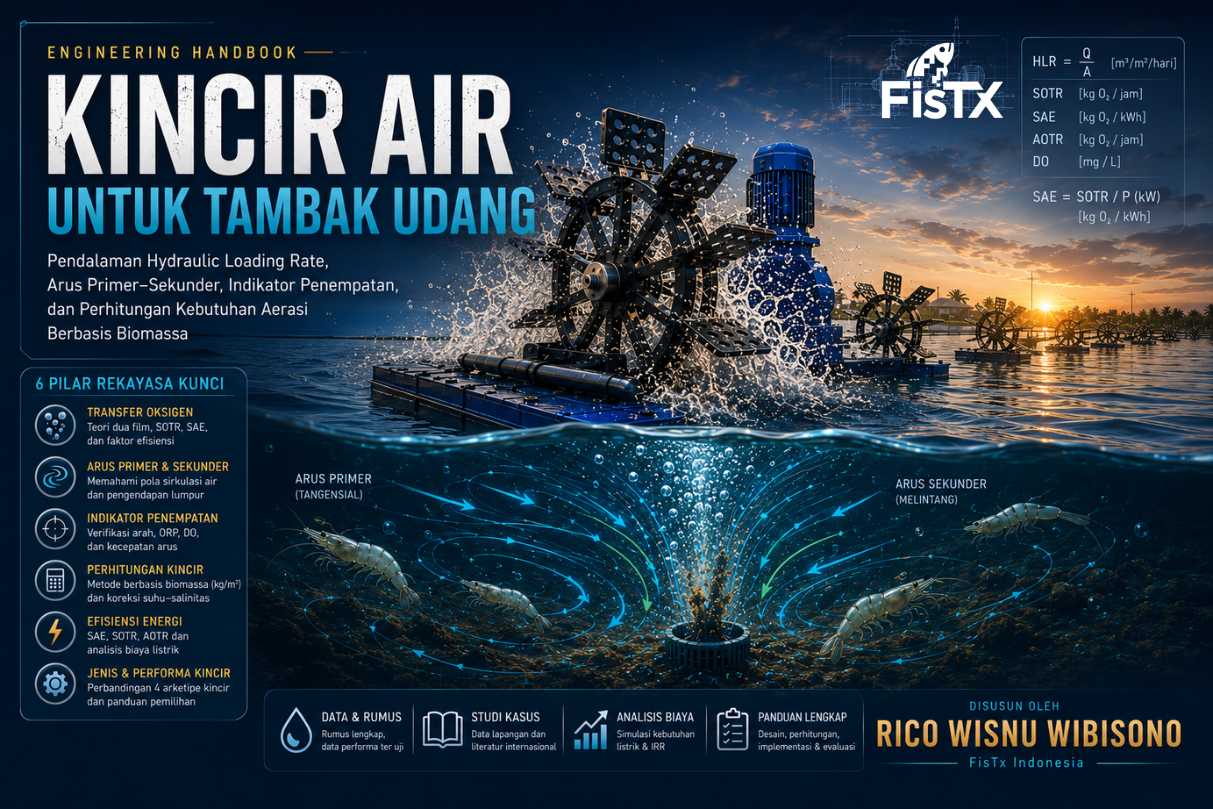
In the latest e-book, "Water Paddle Wheels for Shrimp Ponds," Rico Wisnu Wibisono, Founder & CEO of FisTx, explains the six core engineering principles behind paddle wheel performance through a systematic, science-based approach. The book covers oxygen transfer physics, hydraulic loading rate (HLR), primary and secondary water circulation, measurable paddle wheel placement indicators, biomass-based aerator calculations, and a comprehensive comparison of the four most common paddle wheel designs used in Indonesian shrimp farming.
Every chapter is supported by more than 100 international scientific journals, making this e-book a practical engineering reference rather than a collection of field assumptions or conventional practices.
The e-book is now available for FREE download.
Who Should Read This E-book?
This e-book is designed for:
- Shrimp farm technicians
- Shrimp farm owners and managers
- Aquaculture consultants
- Aquaculture students
- University lecturers and researchers
Anyone who wants to understand paddle wheel aeration from an engineering perspective—not just through field experience—will benefit from this guide.
What's Inside?
Across 14 comprehensive chapters, you'll learn:
- How paddle wheels transfer oxygen based on the Lewis & Whitman Two-Film Theory.
- Primary and secondary water circulation, and why sludge and uneaten feed either accumulate in one location or create harmful dead zones.
- Scientific paddle wheel placement indicators using ORP, DO, and sediment distribution instead of visual estimation.
- Biomass-based formulas for calculating the optimal number and size of paddle wheels, including temperature and salinity corrections.
- A comparison of four paddle wheel designs—Taiwan, Gear (Chain), Spiral, and Movable Blade—with aeration efficiency (SAE) and investment return (IRR) data from international studies.
- Implementation checklists and field measurement protocols for Standard Oxygen Transfer Rate (SOTR) and Standard Aeration Efficiency (SAE).
Every topic is supported by over 100 peer-reviewed scientific publications, providing reliable technical guidance for real-world shrimp farming operations.
Why Should You Read It?
Many dissolved oxygen (DO) failures in intensive shrimp ponds are not caused by having too few paddle wheels, but by poor placement and incorrect engineering calculations.
This e-book will help you:
- Calculate the correct aeration horsepower (HP) requirements.
- Select the most suitable paddle wheel design for your pond conditions and investment budget.
- Optimize water circulation to reduce sludge accumulation.
- Detect circulation problems before they affect FCR, shrimp health, and survival rate.
- Improve aeration efficiency while reducing unnecessary electricity costs.
Whether you're designing a new pond or improving an existing one, this guide provides practical engineering knowledge that can immediately be applied in the field.
Download the Free E-book
The e-book is available free of charge.
Read More Articles

Pangkep State Agricultural Polytechnic and Fistx Indonesia Establish Cooperation to Develop a Centre of Excellence for Ornamental Coral Cultivation
15 December 2025
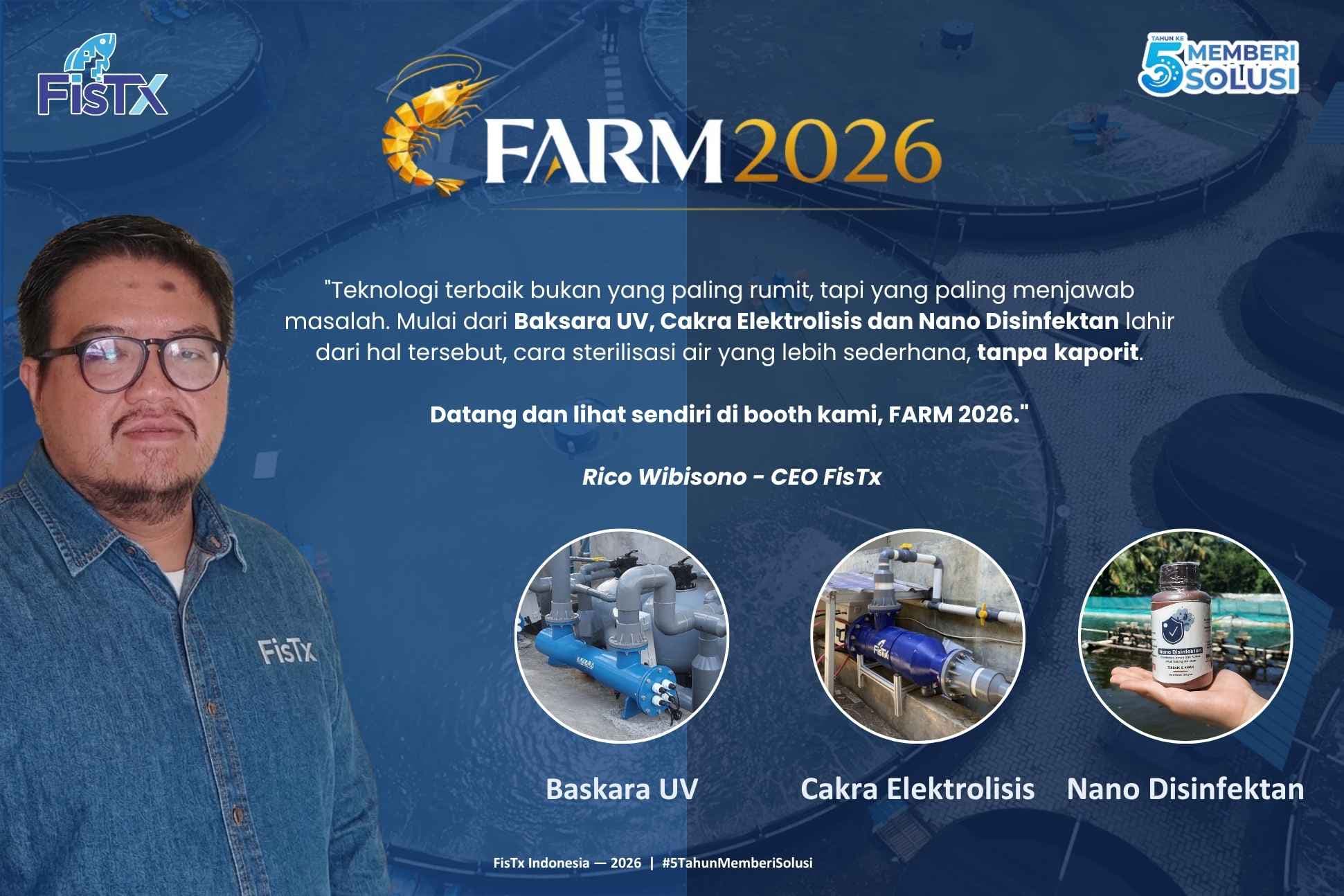
Chlorine-Free Pond Water Sterilization: FisTx Introduces FDS Technology at FARM 2026
17 September 2026
Nano Particle Technology Disinfectant for Shrimp, More Effective and Safe in Combating Diseases
26 September 2023