Plan Your 2027 Shrimp Cycle Using Data, Not Gut Feeling: A Free 12-Chapter E-Book
What Is the FisTx Shrimp Farming Encyclopedia?
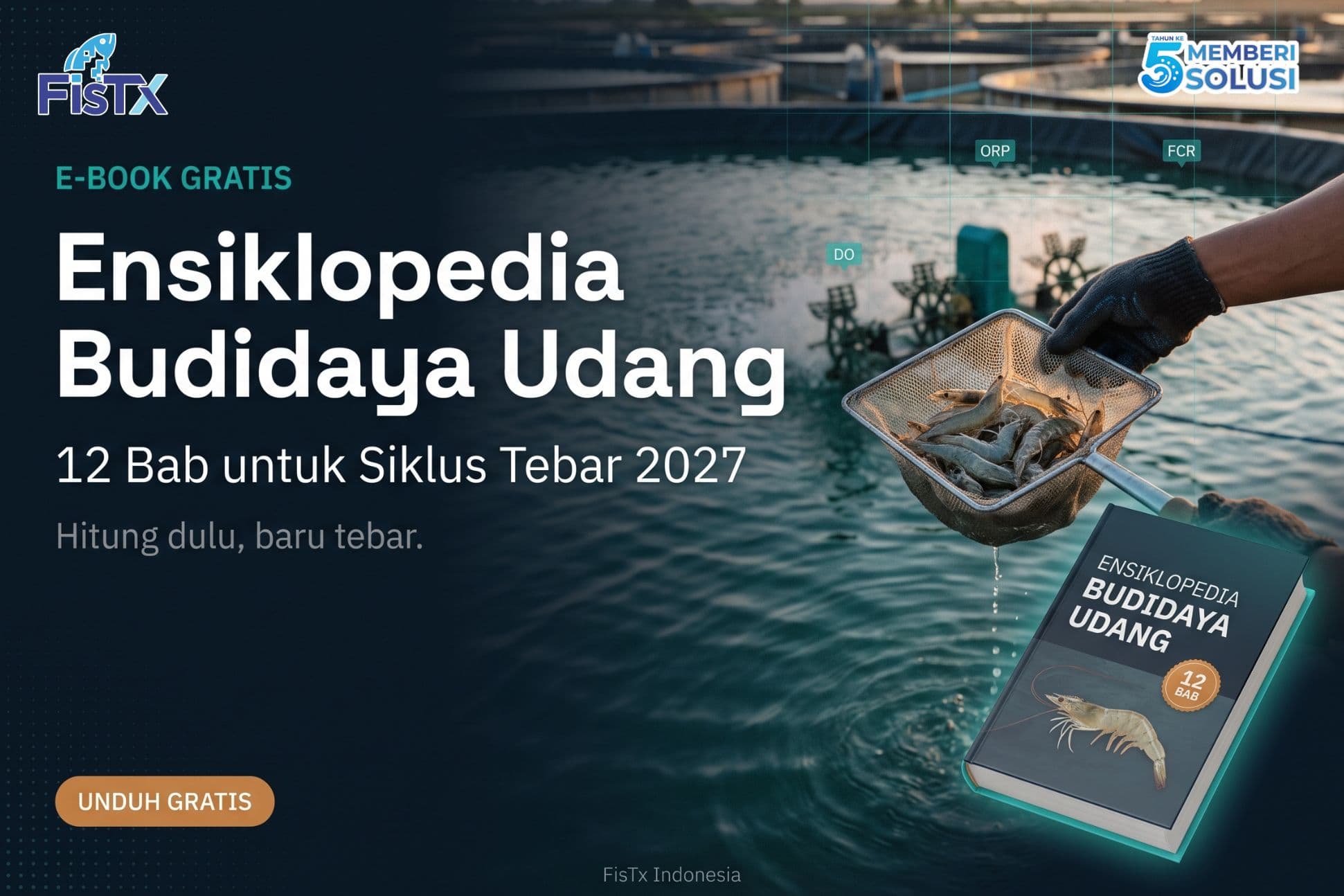
The Shrimp Farming Encyclopedia (Ensiklopedia Budidaya Udang) is a free 12-chapter e-book by Rico Wisnu Wibisono, CEO of FisTx Indonesia. It covers vannamei shrimp farming with a measured, data-based approach: stocking, water quality, oxygen, hydraulics, genetics, microbiome, feed, biosecurity, monitoring, cycle economics, and sustainability. It is made for pond farmers, technicians, and farm managers who are preparing for the 2027 cycle. The format is PDF, and you can download it free on this page.
Why Read It Now: The 2027 Cycle Starts With Today’s Decisions
Before the postlarvae go into the pond, part of your harvest is already decided: how many you stock, how you manage the water, how many aerator horsepower (HP) support each ton of shrimp, and at what number you dare to raise feed. These decisions are cheap to change on paper and expensive to change when the shrimp are already 40 days old.
Many farms repeat old habits because they have never seen the numbers broken down. Ecuador is the clearest example. The country almost lost its industry in 1999, then rose to become the world’s largest shrimp exporter. The first chapter of this encyclopedia shows that this comeback was not about stocking more densely. It was about measuring correctly.
The encyclopedia is built so you can read it with one simple question in mind: what should I change before my next stocking? Every chapter ends with a principle you can take straight into your farm team meeting.
Three things you will take away
- How to calculate and compare: measured stocking, pond carrying capacity, and production cost (HPP) per kilogram, instead of just saying “my pond is good.”
- How to read your pond: when it is green, yellow, or red, with clear thresholds.
- How to decide: water, oxygen, feed, and biosecurity connected in one decision loop, instead of five separate habits.
Inside the Encyclopedia: 12 Chapters in 3 Parts
The book moves from the basics to daily decisions, then to business resilience. You can read in order, or jump straight to the chapter closest to your pond’s problem.
Part 1. Foundations: measure first, then stock
| Chapter | Title | What you get |
|---|---|---|
| I | Shrimpnomic | The Ecuador story, the logic of measured stocking, and the difference between SPR and SPF postlarvae |
| II | Water Thinking | Managed water exchange versus biofloc, with data from the Belimbing Sari farm |
| III | Carrying Capacity | Pond anatomy, the “tiki-taka” concept, and how to raise carrying capacity per HP |
| IV | Oxygen Economics | Aerators, DO and ORP, plus the SOTR and SAE measures |
Part 2. The pond engine: how a farm really works
| Chapter | Title | What you get |
|---|---|---|
| V | Pond Hydraulics | Flow rate, head, pipe diameter, and saving energy with VFDs |
| VI | Genetics and Resilience | SPF and SPR, genetics-environment interaction, and the trade-off between fast growth and resistance |
| VII | Measured Microbiome | The bacteria saturation point, Vibrio, nano silver and copper, and measured probiotics |
| VIII | Measured Feeding | Samocha-style flat feeding, the protein myth, and the energy map |
Part 3. Survive and win: disease, data, money
| Chapter | Title | What you get |
|---|---|---|
| IX | Health and Biosecurity | The disease triangle and 7 layers of biosecurity |
| X | Monitoring and Data | Pond vital signs, green-yellow-red thresholds, and the decision loop |
| XI | Cycle Economics | Cost structure, HPP, cash flow, and sensitivity analysis |
| XII | Sustainability and the Future | The three pillars of sustainability and where the industry goes next |
Where should you start? If your pond often has oxygen drops, start with Chapter IV. If your production cost feels too high, start with Chapters VIII and XI. If you often face disease, start with Chapter IX.
Who It Is For, and What You Will Not Find
Good for:
- Farmers who want to lower production cost without guessing
- Farm technicians and supervisors who need reference numbers for meetings and SOPs
- Owners or investors who want to understand the economics of one cycle before adding ponds
- Students and fisheries extension workers looking for a structured reference in Indonesian
What to know before you download:
| Concern | The answer |
|---|---|
| “This must be a product brochure.” | This is a book of science and numbers. It covers farming principles, not a product catalog. |
| “Too theoretical.” | Each chapter uses real cases and field numbers, and ends with a principle you can apply right away. |
| “I’ll get calls from sales.” | There is no obligation at all. Download first, decide later. |
| “Too long to read.” | Read it chapter by chapter. Each chapter stands on its own. |
| “I have to fill in a lot of data.” | The form has only five fields and takes about one minute. |
About the Author: Rico Wisnu Wibisono
Rico Wisnu Wibisono is the CEO of FisTx Indonesia (PT Aditya Inovasi Makmur), an aquaculture technology company based in Yogyakarta. He has written several farming e-books used by pond farmers and technicians, and he put his field experience and literature references into this Shrimp Farming Encyclopedia series.
FisTx carries the vision #Prosperity in Our Hand: technology and farming knowledge that make pond farmers more prosperous.
How to Download the Shrimp Farming Encyclopedia
Click the link below to download the e-book for free: CLICK THE LINK
Frequently Asked Questions
Is the Shrimp Farming Encyclopedia really free?
Yes. You can download the whole 12-chapter series as PDFs at no cost, and you do not have to buy any FisTx product.
How many chapters are there, and what do they cover?
There are 12 chapters in total: Shrimpnomic, Water Thinking, Carrying Capacity, Oxygen Economics, Pond Hydraulics, Genetics and Resilience, Measured Microbiome, Measured Feeding, Health and Biosecurity, Monitoring and Data, Cycle Economics, and Sustainability and the Future.
Who is the author?
Rico Wisnu Wibisono, founder and CEO of FisTx Indonesia.
Is this e-book only for intensive farms?
The deepest coverage is on intensive vannamei farming that uses aeration and measured water management. The measuring principles can still be used at other scales, with adjusted numbers.
I am a beginner. Can I understand it?
Yes. Each chapter opens with a case and explains the technical terms. Beginners should start with Chapters I and II, then jump to the chapters that match their needs.