Vannamei Shrimp Look Weak Even Though You Feed Enough? 3 Layers Often Missed on the Farm
Feed is given on time and in the right amount, yet the shrimp are still weak and eating less. Feed is only one part of the equation: shrimp can use it well only if their water, digestive organ, and nutrient absorption are working normally.
Quick answer: vannamei shrimp that are weak even when feeding is enough are often linked to three things: worsening water quality (ammonia, nitrite, organic matter), Vibrio pressure on the hepatopancreas, and poor nutrient absorption. Check them in order, starting with water parameters, then the condition of the hepatopancreas and gut, and only then review the feed.
The regulator is saying something similar. The Director General of Aquaculture at Indonesia's Ministry of Marine Affairs and Fisheries (KKP) named good aquaculture practice, environmentally friendly technology, and biosecurity as the keys to keeping shrimp quality high from the start of the cycle (investortrust.id, 29/9/2025). The three layers below are a practical way to put that into the pond.
Layer 1: Water, where problems usually begin
Water quality is the first thing to check, because every other layer depends on it. Leftover feed, dead plankton, and feces build up as organic matter, which breaks down into ammonia, nitrite, and nitrate. At certain concentrations, these compounds are toxic to shrimp (Trunojoyo University).
A study at a semi-intensive pond in South Lampung (September to December 2024) found significant increases in total organic matter (TOM), ammonia, nitrite, and phosphate at days of culture (DOC) 43 to 50. This stage usually coincides with growing biomass and larger daily feed amounts. The researchers linked poor water quality to slower growth, higher disease risk, and even mass mortality (Undip, Maquares).
A similar pattern shows up in intensive ponds. Research from IPB found that the water in grow-out ponds became more and more like discharge water as DOC increased. Several parameters (pH, ammonium, nitrite, nitrate, alkalinity, and total Vibrio) are suspected to be linked to outbreaks of AHPND, white feces disease, and white spot (IPB). Research from Airlangga University adds that ponds infected with white feces disease were dominated by Vibrio vulnificus, an opportunistic bacterium that multiplies fast when conditions get worse (Unair).
On the control side, research from Undip reports that probiotics affect water quality and Vibrio populations, and that Bacillus spp. are among the bacteria commonly used for this purpose (Undip, IJMS).
What you can do today: measure water parameters regularly and track the trend, not just a single reading. For reference, the South Lampung study measured temperature, pH, DO, salinity, and water clarity three times a day, and ammonia, nitrite, alkalinity, TOM, plankton, and Vibrio every seven days.
Layer 2: The hepatopancreas, the "kitchen" that often gets overlooked
The hepatopancreas is the main organ for digesting and absorbing feed, so problems here quickly show up as weak shrimp that eat less.
AHPND is caused by strains of Vibrio parahaemolyticus that carry the pirA and pirB genes, and its toxins damage the hepatopancreas. In challenge tests, infected shrimp showed a pale hepatopancreas, an empty gut, and sluggish movement (IPB). A UGM study on shrimp with AHPND-like symptoms in Purworejo recorded a brownish to pale hepatopancreas, red spots on the telson and uropods, yellowish legs, and an empty gut. In the larval stage, this disease can cause up to 100% mortality (UGM).
However, not every case with similar symptoms is AHPND. A UGM study in Bali isolated several disease-causing Vibrio, including V. parahaemolyticus and V. harveyi, with a pale hepatopancreas and an empty digestive tract, but none of them caused AHPND (UGM). Symptoms in the pond alone are not enough to tell what the cause is.
What you can do today: take a shrimp sample and check the color of the hepatopancreas and what is inside the gut. If something looks suspicious, confirm with a laboratory test such as PCR before deciding on treatment (UNESA).
Layer 3: Nutrient absorption, feed going in is not always feed absorbed
FCR (feed conversion ratio) is the amount of feed needed to add 1 kg of shrimp weight; the lower the number, the more efficiently the feed is used. This matters for your finances because feed is described as the largest production cost in aquaculture (Bisnis.com, 2021).
If water and the hepatopancreas are under control but FCR is rising or weekly growth is falling behind, look at these three things:
- Feed attractiveness: how quickly shrimp respond when feed is given, and how much is left on the feeding tray.
- Absorption: whether the feed that is eaten is really used, or whether much of it is wasted as leftovers and feces.
- Minerals during molting: shrimp shed their shells regularly and need minerals to build a new shell and keep their osmotic balance, so the supply of minerals can become a limiting factor.
What you can do today: record FCR and weekly growth for each pond, then compare them with your targets and with other ponds at the same stage. The gap shows which layer to deal with first.
Quick check: from what you see in the pond to the layer to inspect
This table helps you decide which layer to inspect first. Treat it as a starting guide, not a diagnosis.
| Sign in the pond | Layer | First step |
|---|---|---|
| Cloudy or foamy water, or blooming; ammonia and nitrite going up | Water | Measure ammonia, nitrite, alkalinity, and DO; check leftover feed and organic matter on the pond bottom |
| Sudden drop in appetite, empty gut | Hepatopancreas and Vibrio | Check the color of the hepatopancreas and the gut contents in a sample; do a lab test if needed |
| Pale or brownish hepatopancreas, red spots on the tail | Hepatopancreas | Confirm the cause (for example, with PCR) and review biosecurity |
| Slow growth, rising FCR, uneven sizes | Nutrient absorption | Compare FCR and weekly growth with targets; make sure water and hepatopancreas are healthy first |
| Molting is not synchronized, new shells harden slowly | Minerals | Check alkalinity, calcium, and magnesium; review mineral supplementation |
For measuring in the pond, the Nawasena Test Kit from FisTx tests ammonia, nitrite, alkalinity, DO, and Ca-Mg in real time.
Aqua Support FisTx: support for every layer
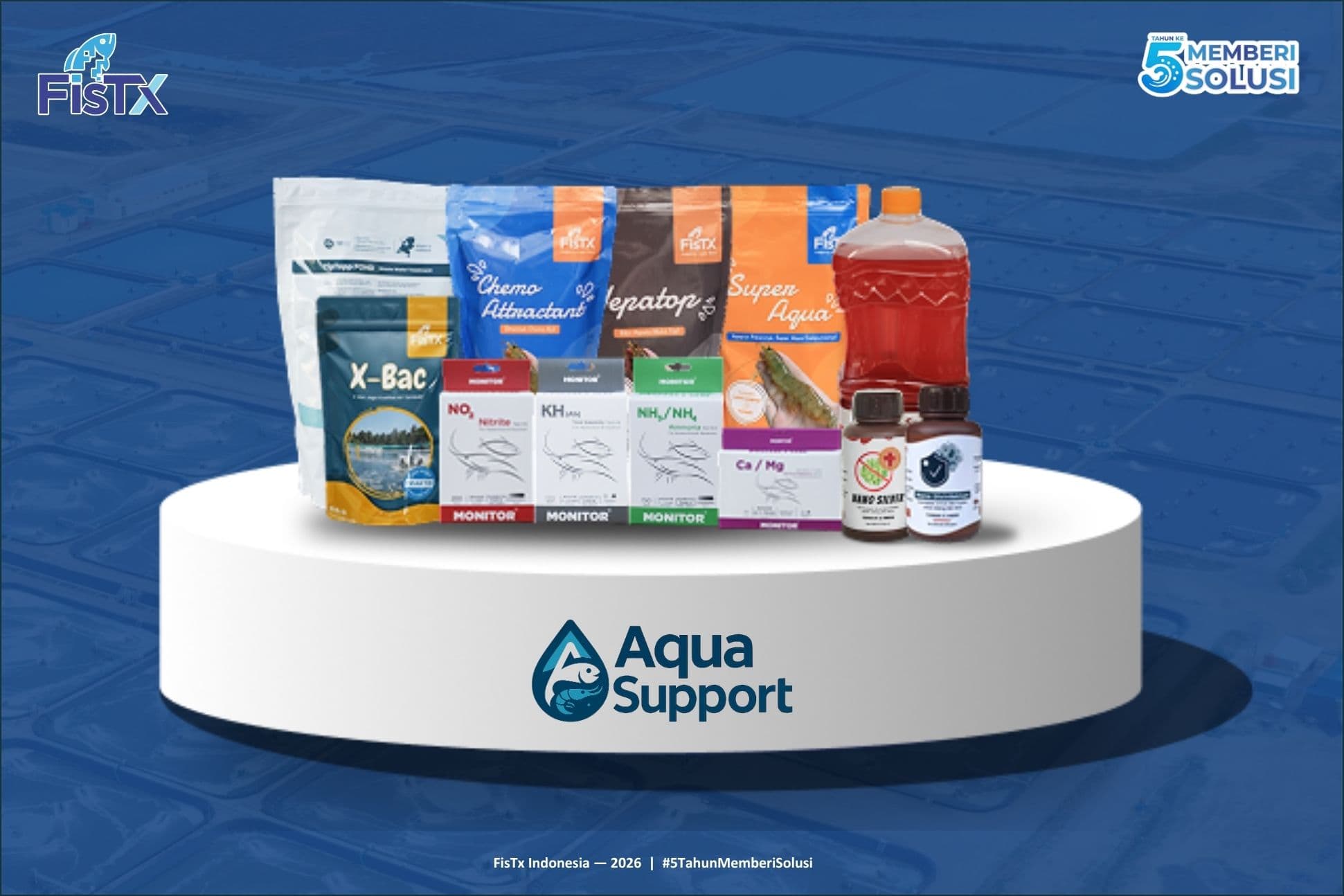
Based on these three layers, FisTx put together Aqua Support, a product line for the water quality and nutrition needs of shrimp. Choose based on your pond measurements; you do not need everything at once.
| Need | Product | What the product states |
|---|---|---|
| Dirty water, blooming, Vibrio dominance | TipTopp Pond | A probiotic with 7 Bacillus species that helps break down organic matter, manage ammonia and nitrate, and suppress Vibrio growth |
| Keeping pond water quality stable | X-BAC PRO | A probiotic with 7 Bacillus species that helps maintain pond water quality |
| Hepatopancreas support | Hepatop | A feed additive with a feed adsorbent and a feed absorption catalyst; contains milk thistle, bentonite, beta-glucan, nucleotides, trace minerals, and multivitamins. Helps support hepatopancreas function and protect against exposure to fungi, toxins, and Vibrio. Label dose: 2 g/kg of feed, from the start of stocking until harvest |
| Feed attractiveness and absorption | Chemo-Attractant | Probiotics, prebiotics, and garlic extract to support feed attractiveness, nutrient absorption, and immunity |
| Minerals and molting | Super Aqua | 13 vitamins and 7 minerals to support immunity, osmotic balance, and mineral needs during molting |
Aqua Support is a supporting product. It is not a medicine and does not replace good pond management or biosecurity. Results depend on pond conditions, so use the products according to the label instructions.
Frequently asked questions
What causes vannamei shrimp to be weak even when feed is enough?
Weak shrimp despite enough feed are often linked to worsening water quality, Vibrio pressure on the hepatopancreas, or poor nutrient absorption. The exact cause should be confirmed through water measurements, a check of the hepatopancreas and gut, and a laboratory test when needed.
How can I tell a water problem from a hepatopancreas problem?
Start with water: measure ammonia, nitrite, alkalinity, and DO. If the parameters look normal but the shrimp stop eating, the gut is empty, and the hepatopancreas is pale or brownish, shift your focus to the hepatopancreas. Both can happen together, because worsening water supports Vibrio growth.
Are Bacillus probiotics enough to suppress Vibrio?
Probiotics are one tool, not the only one. Research from Airlangga University says water quality management, biosecurity, and probiotics can be aimed at specific disease causes (Unair). So probiotics are best combined with good organic matter management and biosecurity.
When is water quality most likely to decline?
In the semi-intensive pond study in South Lampung, organic matter, ammonia, nitrite, and phosphate rose significantly at DOC 43 to 50 (Undip, Maquares). The timing differs from pond to pond depending on stocking density and system, so track the trend daily and weekly.
What is the dose of Hepatop?
The Hepatop label states a dose of 2 g/kg of feed, given from the start of stocking until harvest. Use it according to the instructions on the package, and ask the FisTx team if you are unsure.
Start with data, not guesses
Weak shrimp rarely have a single cause. A sensible order of work is water first, then the hepatopancreas, then nutrient absorption. With records of water parameters, DOC, and FCR, the cause becomes much easier to narrow down.
Do you have pond data you would like to review together? The FisTx team is happy to talk:
- Phone: +62 823-2354-5511
- Web: www.fistx.co.id
Prosperity in Your Hands