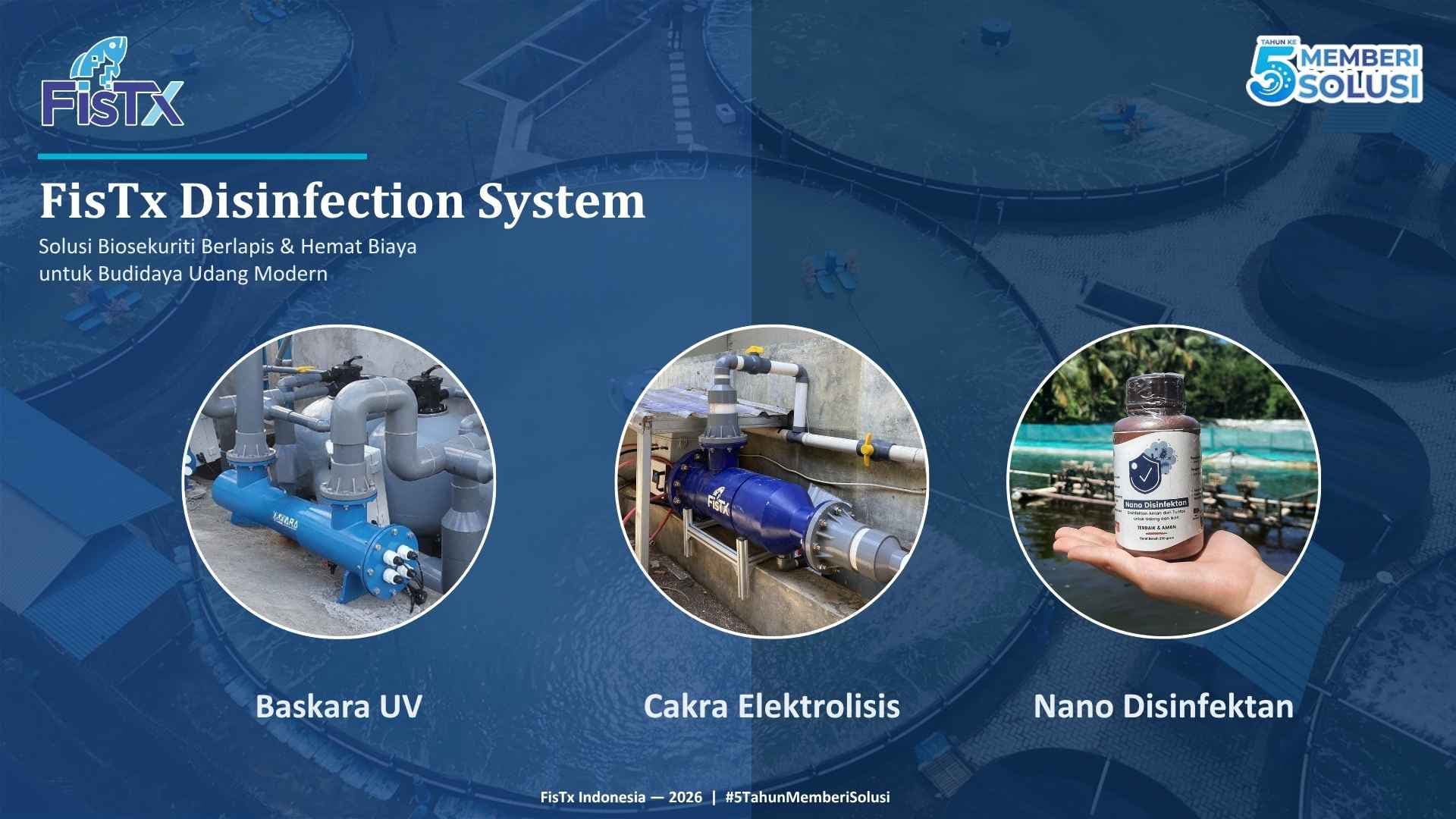
FisTx Disinfection System: Chlorine-Free Pond Water Sterilization
For decades, chlorine (kaporit) has been the default answer for sterilizing shrimp pond water. But that answer keeps getting more expensive — literally. Rising costs, chemical residue that settles at the bottom of the pond, and Vibrio bacteria that keep coming back even after "sterilization" are complaints almost every intensive shrimp farmer has faced at some point.
Today, FisTx Indonesia is officially introducing the FisTx Disinfection System (FDS) — the first pond water biosecurity system to combine three non-chemical sterilization technologies in one integrated setup: Baskara UV, Cakra Elektrolisis, and Nano Disinfektan. Each one is designed to protect a different, critical stage of the water's journey — from the moment it enters the pond to the day of harvest.
This article explains what FDS is, how each layer of technology works, what the field data and case studies show, and how this system solves the classic problems of chlorine-based sterilization.
What Is the FisTx Disinfection System (FDS)?
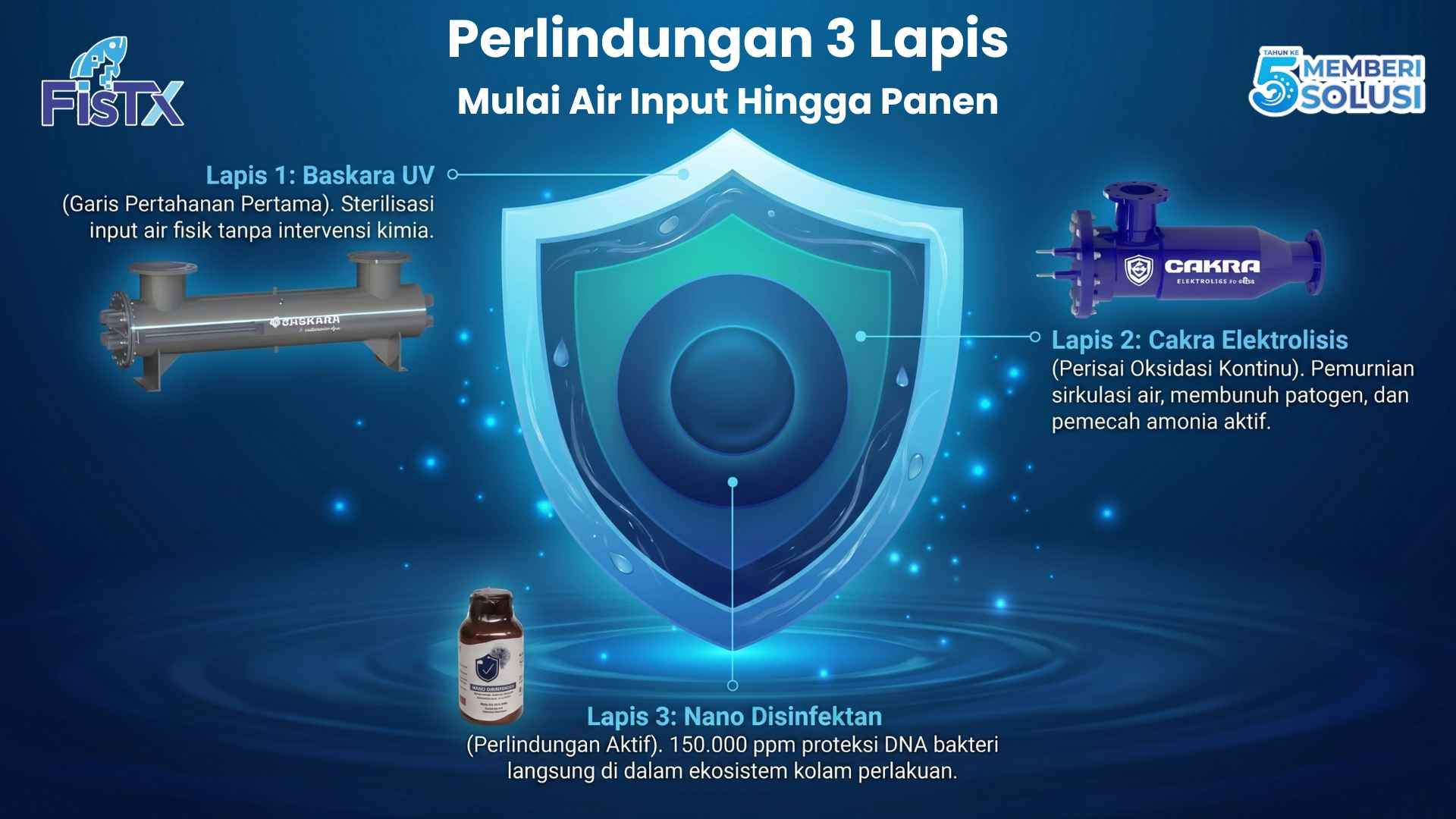
The FisTx Disinfection System (FDS) is an integrated pond water sterilization system that combines three non-chemical technologies — Baskara UV (UV-C light), Cakra Elektrolisis (electrochemical oxidation), and Nano Disinfektan (nano copper ions) — to provide layered biosecurity protection from incoming water all the way through to harvest. Unlike chlorine, which only works once at the start of a cycle, FDS is built to work continuously throughout the entire farming cycle.
FisTx calls this core concept 3-Layer Protection: each technology guards a different stage of the water's journey, closing off the gaps that pathogens usually exploit to come back.
Why Farmers Are Moving Away From Chlorine-Based Sterilization
Relying on chlorine as the main disinfectant runs into four structural problems that are becoming harder to ignore in modern intensive shrimp farming:
💸 High and rising costs. A standard chlorine dose of 30 ppm for a 1,000 m² pond can cost as much as Rp 44 million (roughly USD 2,700) per cycle, with sterilization costs reaching Rp 1,200 per m³. For farms with multiple ponds, these numbers add up fast and eat directly into margins.
📉 Stalled productivity. Unstable water quality causes chronic stress in shrimp, lowers FCR (feed conversion ratio), slows growth, and increases mortality.
🦠 Pathogens that keep coming back. Resistant Vibrio bacteria often reappear once chlorine's effect wears off, because chemical sterilization is a one-time hit — it doesn't offer continuous protection.
☠️ Residue that harms the ecosystem. Leftover chlorine and organochlorine compounds can poison aquatic life and suppress the beneficial bacteria that ponds actually need to stay in balance.
These four problems are exactly what FDS was built to address — not as a one-to-one replacement for chlorine, but as a layered approach that attacks conventional sterilization's weak points on cost, sustainability, and environmental safety.
Related reading (Indonesian): Efisiensi Biaya Produksi: Strategi Sterilisasi Air Tambak Udang untuk Keuntungan Maksimal and Solusi Sterilisasi Air Tambak Udang: Kombinasi UV & Elektrolisis
3-Layer Protection: From Incoming Water to Harvest
Instead of relying on a single sterilization point at the start of the cycle, FDS places three technologies at three different critical points along the water's journey:
Layer | Technology | Where It Works | Main Function |
| 1 | Baskara UV | Incoming water / intake channel | Initial sterilization before water enters the pond |
| 2 | Cakra Elektrolisis | Pond water / recirculation | Maintains water quality throughout the cycle, works even in turbid water |
| 3 | Nano Disinfektan | Throughout the cycle & in feed | Continuous protection, day-to-day bacteria and virus control |
This layered approach means that when one layer has a limitation — for example, UV losing effectiveness in cloudy water — another layer is already there to close the gap.
Layer 1 — Baskara UV: Chemical-Free Sterilization of Incoming Water
Baskara UV is a UV-C (ultraviolet-C) sterilization unit that eliminates pathogens in incoming pond water without leaving any chemical residue. It works at a wavelength of 253.7 nanometers — the UV-C wavelength scientifically proven most effective at damaging the DNA/RNA of microorganisms, so pathogens can no longer reproduce or infect shrimp.
Key technical specifications of Baskara UV:
Parameter | Specification |
| Wavelength | 253.7 nm (UV Medium Pressure) |
| Minimum UV Transmittance (UVT) | >75% |
| UV-C lamp lifespan | 12,000 hours (4x longer than standard lamps) |
| Product variants | UV 2-Inch, UV 4-Inch, UV 8-Inch, UV Open Channel |
Because it works purely with light, Baskara UV leaves no chemical residue in pond water and is ideal for installation at the water intake or in a recirculation system — though its effectiveness does depend on water clarity, so it's best paired with adequate filtration.
Field case studies:
- CV Sumber Hatchery Bangka (SHB): uses an 8-Inch UV Medium Pressure unit with Ultrafiltration and Pressure Filter systems, installed since 2022.
- Agro Udang Manis Farm, Bali: before installation, the farm harvested a total of 8.76 tons at a 73% survival rate (SR), with a harvest size of 86 (count per kg). After installing Baskara UV, total harvest rose to 13.6 tons, and harvest size improved to 37 (count per kg) — meaning the shrimp were harvested significantly larger per piece.
Layer 2 — Cakra Elektrolisis: Water Sterilization Through Electrochemical Oxidation
Cakra Elektrolisis is a pond water treatment technology based on electrochemical oxidation that generates a natural disinfectant compound (HOCl) directly from the water itself, producing bacteria-free water even in turbid conditions. This makes it an important complement to Baskara UV, whose effectiveness drops as water turbidity increases.
Technical specifications of Cakra Elektrolisis:
Parameter | Specification |
| Power | 0 – 12 kW |
| Input Voltage | 380V 3-Phase / 220V 1-Phase |
| Output Voltage | 0 – 12 VDC |
| Output Current | 250A – 1000A |
| Effectiveness | 80 – 90% |
| Material | Titanium Gr-1, SS304, Copper, Nylon |
| Flow Rate | 50 m³/hour (up to 200 m³/hour) |
| Dose | 2 ppm HOCl |
| Features | Adjustable voltage, adjustable current, auto switch |
Field evidence: Independent lab testing by PT Suri Tani Pemuka (JAPFA) Animal Health & Laboratory Service in Banyuwangi confirmed improved water quality parameters after FisTx technology was installed. In the first harvest cycle following the installation of Cakra Elektrolisis (July 2026), one partner pond recorded an 82% survival rate — a solid result for a first cycle right after installing new technology.
Layer 3 — Nano Disinfektan: Continuous Protection Throughout the Cycle
Nano Disinfektan is a liquid disinfectant based on 150,000 ppm nano copper ions that directly destroys the cell membranes of bacteria, viruses, and algae — without the risk of resistance — and is safe to mix into both feed and water. Unlike chlorine, whose effect fades after a short time, Nano Disinfektan is designed for regular use throughout the entire farming cycle as a last line of continuous protection.
Effectiveness testing shows Nano Disinfektan can control bacteria, viruses, Vibrio, and other waterborne pathogens by up to 90%. The copper (Cu) ion mechanism works in four stages:
- Cell Damage — Cu ions dissolve from the surface and damage the pathogenic bacteria's cell wall.
- Membrane Rupture — pressure from Cu ions ruptures the cell membrane, causing the cell to lose its cytoplasm.
- Oxygen Radicals — Cu ions trigger ROS (Reactive Oxygen Species) that damage the bacteria's genes and DNA.
- Bacteria Killed Off — Cu ions destroy the cell's metabolism, kill the bacteria, and prevent resistance mutations.
Farmer testimonials:
"Vibrio bacteria used to be our biggest problem. Now we can keep it under control with Nano Disinfektan. We've maintained a survival rate above 85% for the last 4 cycles. It's now a mandatory standard product across all our ponds." — Mas Bayu, shrimp farmer in Pangandaran
"Our farm was hit by EHP for 2 cycles straight... after treating it with Nano Disinfektan, we cleared the EHP within 4 weeks, and we also managed to lower our FCR from 1.9 to 1.4." — Bapak Made Aryana, pond owner in Gerogak, Buleleng, Bali
"Our farm dealt with EHP for 2 cycles. After a fellow farmer recommended Nano Disinfektan, and with regular use at the recommended dose, we cleared the EHP within a month." — Haji Noordin, vannamei shrimp farmer in Lampung
FDS vs. Chlorine: Modern vs. Conventional Pond Water Sterilization
Aspect | Chlorine (Conventional) | FisTx Disinfection System (FDS) |
| Type of protection | Single point, one-time hit at the start of the cycle | Layered, works from incoming water through to harvest |
| Chemical residue | Chlorine & organochlorine compounds settle in the pond | No harmful chemical residue |
| Pathogen resistance risk | Vibrio can return and become resistant | Three different mechanisms (UV, electrochemical, Cu ions) lower resistance risk |
| Cost per cycle (1,000 m² pond) | ± Rp 44 million (30 ppm dose) + Rp 1,200/m³ | Upfront equipment investment, more predictable per-cycle operating cost |
| Impact on beneficial bacteria | Suppresses beneficial microbial growth | More selective toward target pathogens |
| Follow-up handling needed | Requires residue neutralization (e.g., sodium thiosulfate) | No chemical neutralization process needed |
| Works in turbid water? | Effectiveness drops with high organic load | Cakra Elektrolisis still works effectively in turbid conditions |
FisTx's Track Record in the Field
FDS isn't a product built from scratch. It's the result of technology FisTx Indonesia has been refining for over five years of operation across 25 provinces and three countries (Kuwait, Timor-Leste, and Bahrain), with more than 40,000 units distributed to over 1,500 farmers, and a documented improvement in farming success rates of up to 83.6% at sites that have adopted its technology.
Who Should Use FDS?
- Intensive and semi-intensive shrimp farms that regularly exchange pond water and need continuous biosecurity, not just a one-time sterilization at the start of the cycle.
- Hatcheries that need consistently pathogen-free incoming water to protect the quality of their fry/larvae.
- Farms that have dealt with repeated EHP, AHPND, White Feces Disease, or Vibrio outbreaks, where single-layer sterilization has proven insufficient.
- Farmers looking to cut long-term chemical costs without sacrificing sterilization effectiveness.
Frequently Asked Questions (FAQ)
What is the FisTx Disinfection System (FDS)? FDS is a pond water sterilization system that combines three non-chemical technologies — Baskara UV, Cakra Elektrolisis, and Nano Disinfektan — to provide layered biosecurity protection throughout the entire shrimp farming cycle.
Can FDS fully replace chlorine? FDS is designed as a non-chemical sterilization approach that works at different points throughout the cycle, so many farmers use it to significantly reduce their reliance on chlorine — especially to address cost, residue, and resistant pathogen problems.
Is Nano Disinfektan safe for shrimp and fish? Yes. Nano Disinfektan, based on nano copper ions, is designed to be safe for shrimp and fish, and safe to mix into both feed and water at the recommended dose.
How long do Baskara UV's lamps last? Baskara UV's UV-C lamps last approximately 12,000 hours — about four times longer than typical standard UV lamps.
Does Cakra Elektrolisis still work in turbid pond water? Yes, Cakra Elektrolisis is based on electrochemical oxidation and is designed to keep working effectively even in turbid conditions, complementing Baskara UV, whose performance is more affected by water clarity.
How do I choose the right Baskara UV size for my pond? The right size (2-Inch, 4-Inch, 8-Inch, or Open Channel) depends on your water flow rate and pond size. FisTx's technical team can help calculate the right specification based on your farm's specific capacity.
Can FDS be installed in stages instead of all three technologies at once? Yes. Many partners start with a single layer — for example, Baskara UV at the water intake — before adding Cakra Elektrolisis and Nano Disinfektan as needs and budget allow.
Conclusion
The FisTx Disinfection System marks a shift in how pond water sterilization is approached: from a one-time chemical fix to a continuous, layered biosecurity system that works from incoming water all the way to harvest day. By combining Baskara UV, Cakra Elektrolisis, and Nano Disinfektan, FDS addresses chlorine's four classic problems at once — rising costs, stalled productivity, resistant pathogens, and residue that harms the pond ecosystem.
Interested in implementing the FisTx Disinfection System at your farm?
Read More Articles
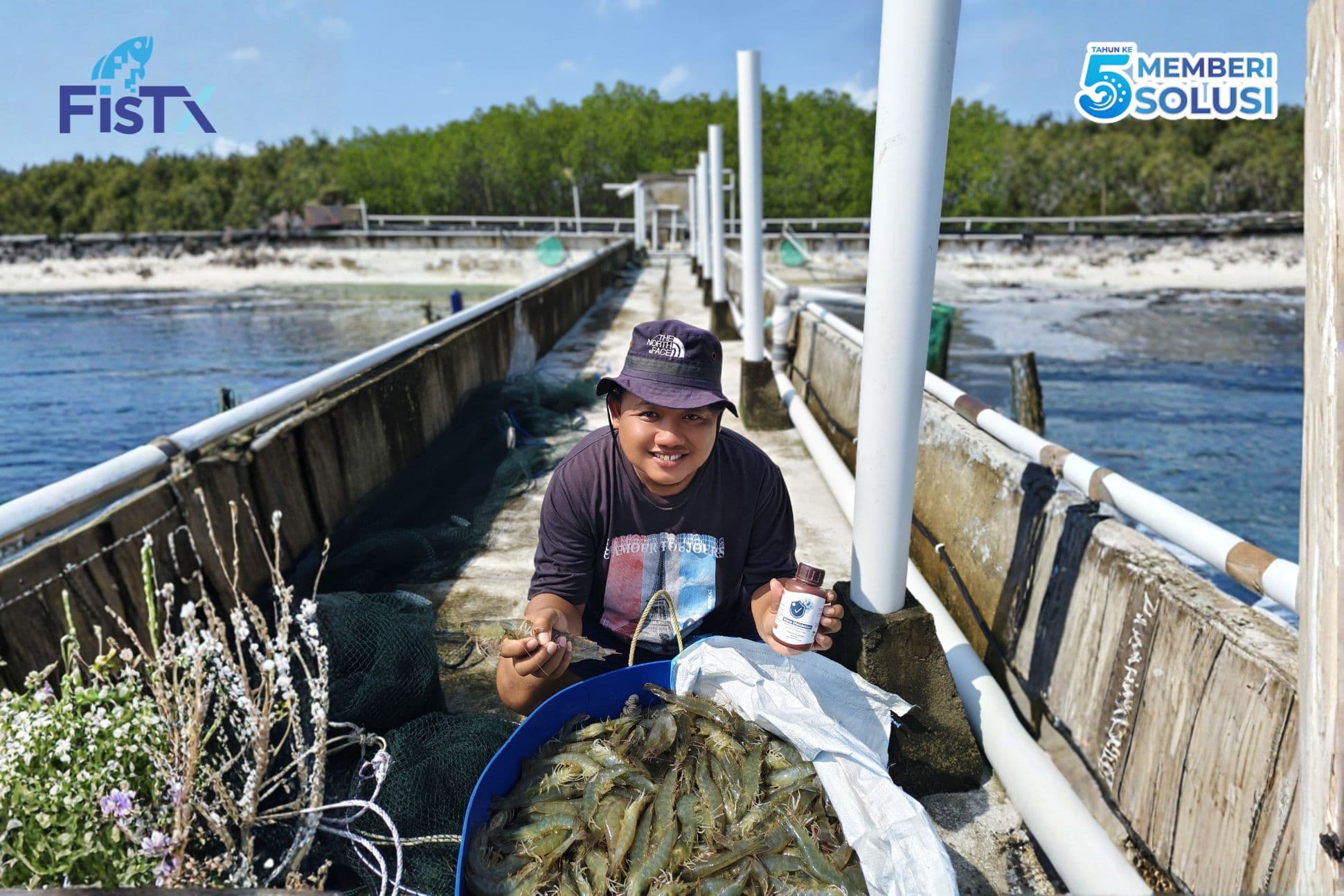
Overcoming EHP Disease in Shrimp with Nano Disinfectants | Pond Biosecurity Solutions
27 February 2026
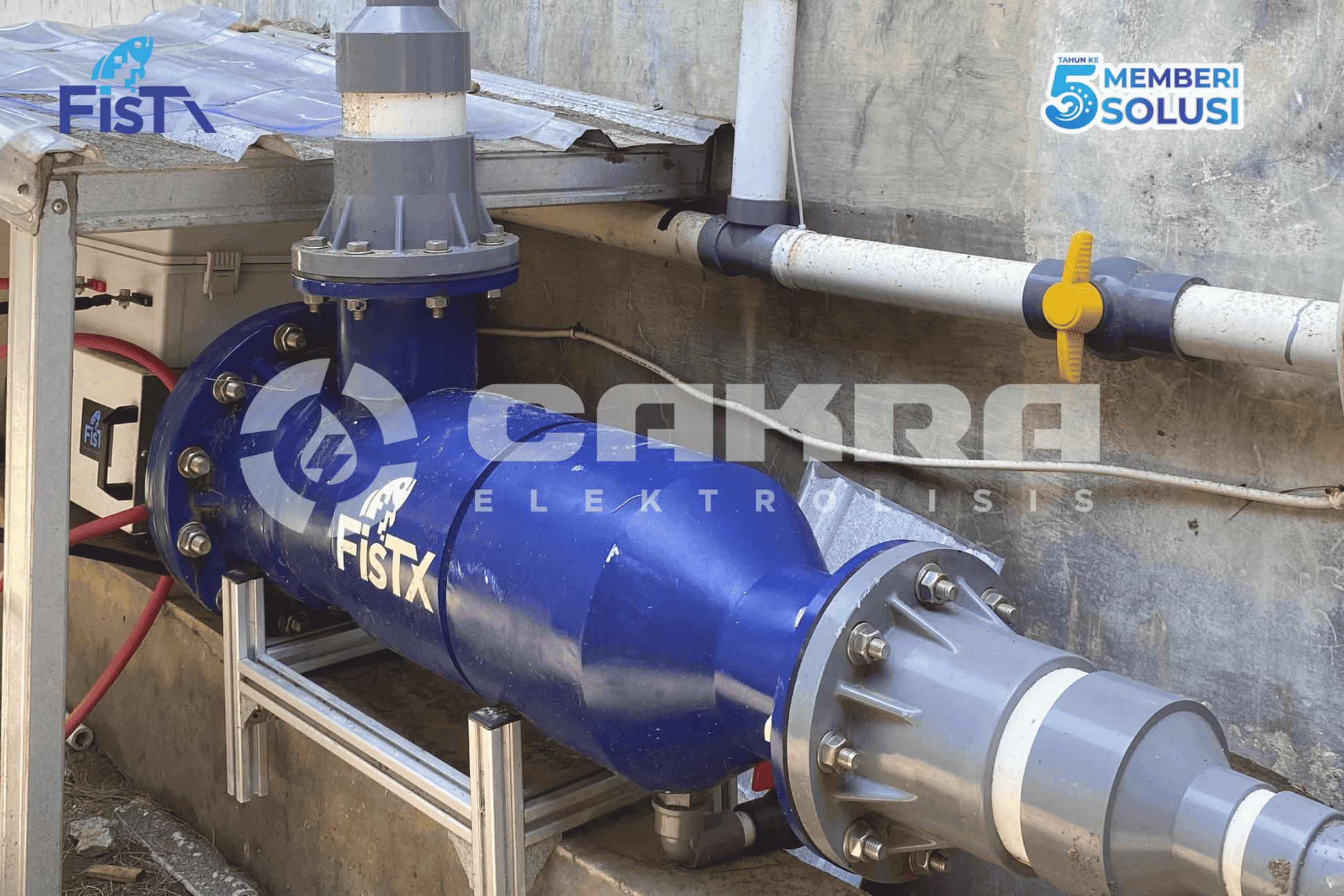
Cakra Elektrolisis : Innovation in Pond Water Sterilisation to Improve the Quality of Indonesian Shrimp Farming
18 December 2025

Improvement Production Shrimp : Strategy and Opportunities Export 2025
25 March 2025